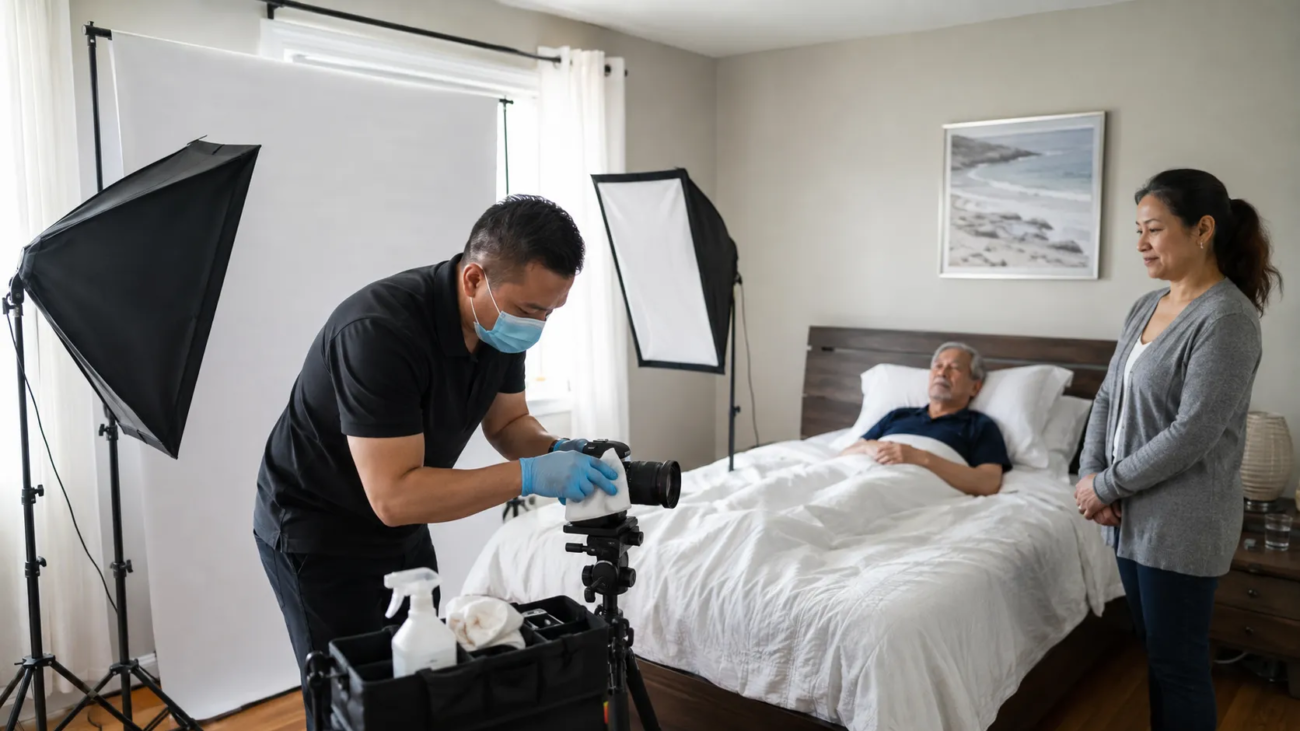
Getting a passport photo is usually a simple task: visit a photography studio, sit in front of the camera, and have your photo taken.
But what happens when the person needing the passport photo cannot leave their bed?
For seniors, patients recovering from surgery, people living with serious medical conditions, individuals in long-term care, or anyone with severe mobility limitations, travelling to a pharmacy or photo studio may be difficult, uncomfortable, or simply impossible.
Fortunately, being unable to sit or stand does not necessarily mean that getting a professional passport photo is impossible.
With the right equipment, positioning, lighting, and an experienced photographer, it may be possible to create a compliant passport photo while the person remains safely in bed.
At Green Day Photography, we provide professional mobile passport photography across Toronto and the GTA, including bedside sessions for seniors, bedridden clients, hospital patients, and individuals with limited mobility.
Our approach is simple: instead of asking the client to adapt to a traditional studio, we bring the studio to the client.
If you are looking for a complete overview of our mobile service, visit our At-Home Passport Photo Toronto page.
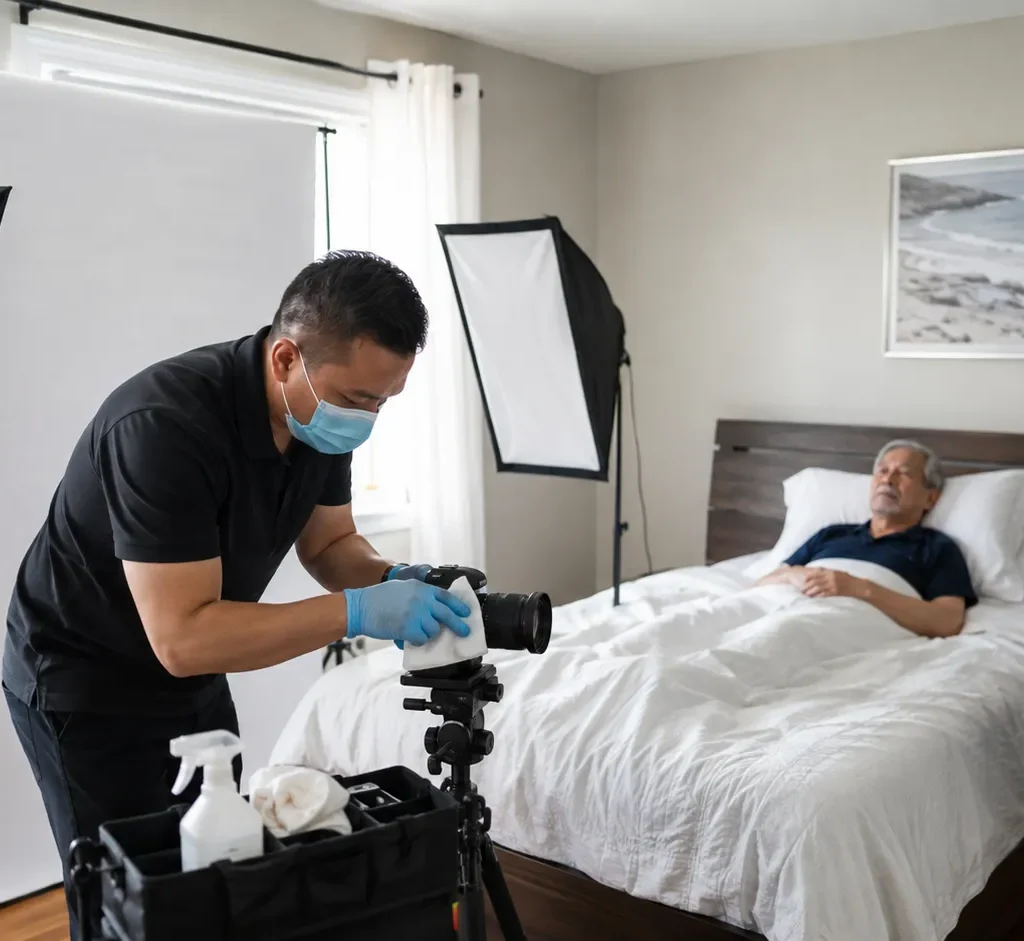
Can You Take a Passport Photo While Lying in Bed?
In many situations, yes.
A passport photograph does not necessarily have to be taken inside a traditional photography studio. What matters is whether the final photograph meets the required specifications.
For a Canadian passport, the Government of Canada requires the face and shoulders to be centred and squared to the camera, the head must not be tilted, the image must have uniform lighting, and the background must be plain white or light-coloured. The standard printed photograph measures 50 mm × 70 mm, with the face measuring between 31 mm and 36 mm from chin to crown.
This means that for a bedridden client, the photographer needs to recreate the geometry of a normal passport photograph while working around the bed.
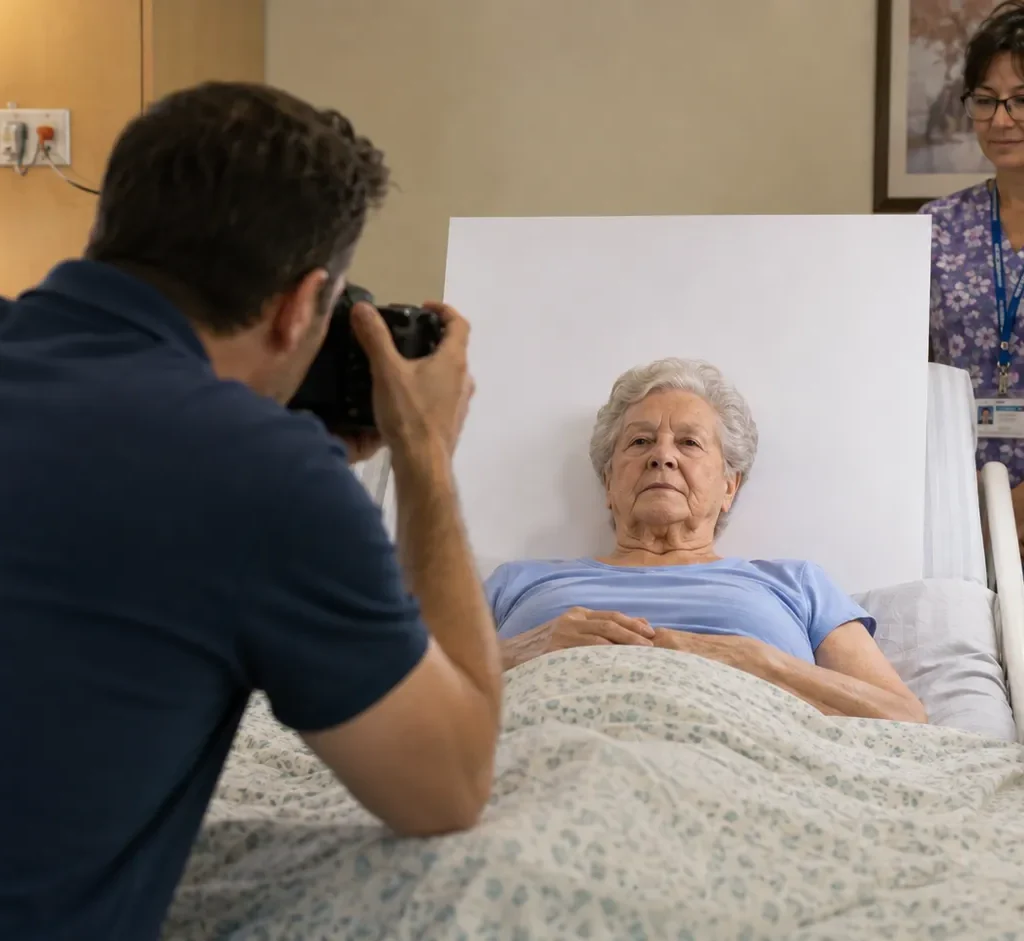
Instead of placing the client in front of the camera, we reposition the camera, backdrop, and lighting around the client.
The goal is to make the camera face the person correctly—not to force the person into an uncomfortable position.
How We Take a Passport Photo of a Bedridden Person
A bedside passport photo session requires more preparation than a regular passport appointment.
The exact setup depends on the client’s medical condition, mobility, bed position, room size, and ability to move their head or shoulders.
Our photographer first evaluates the available space and determines the safest way to position the equipment.
In many cases, a clean white or light-coloured background can be carefully positioned behind the person’s head and shoulders.
The camera is then placed at the correct angle so the face appears straight and centred rather than tilted.
Professional lighting is positioned to produce even illumination and eliminate shadows around the face, ears, shoulders, and background.
Most importantly, the person does not need to make unnecessary movements simply to accommodate the photographer.
We adapt the photography setup around them.
The Camera Angle Is Extremely Important
One of the biggest mistakes when attempting a passport photo on a bed is simply standing beside the patient and photographing downward at an angle.
That may create a usable portrait, but it usually does not look like a compliant passport photograph.
The face may appear distorted, the head may appear tilted, or one side of the face may look larger than the other.
A professional bedside setup is different.
The camera needs to be positioned as close as practically possible to a straight-on relationship with the person’s face.
Depending on the client’s position, this may require:
- adjusting the height of the bed
- slightly repositioning the headrest when medically appropriate
- changing the photographer’s camera height
- photographing from above
- repositioning the portable backdrop
- moving lights around the bed
The photographer—not the patient—does most of the moving.
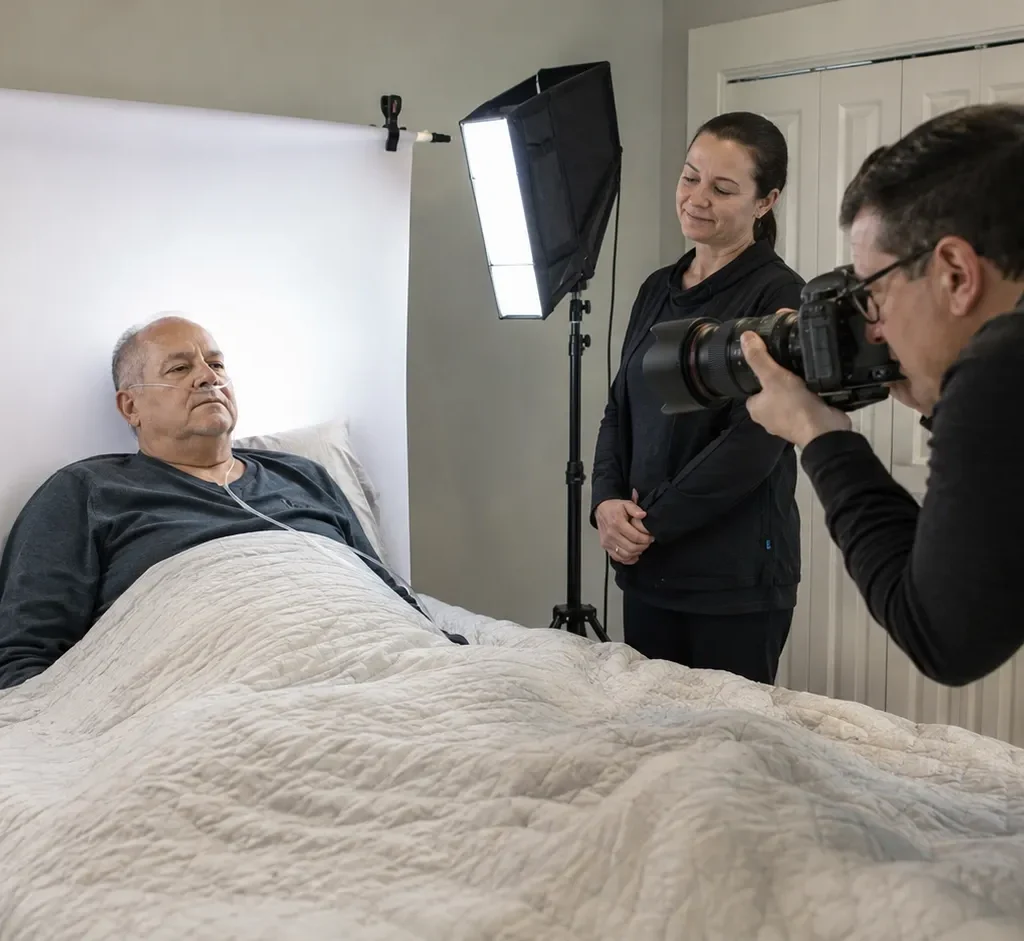
What If the Person Cannot Sit Up at All?
This is one of the most common situations we encounter.
Some clients cannot safely sit upright because of:
- advanced age
- recent surgery
- neurological conditions
- severe weakness
- chronic illness
- injury
- hospitalization
- long-term mobility limitations
In these situations, we do not ask the person to sit up simply for the photograph.
Instead, we assess whether a compliant frontal image can be created while they remain in their medically safe position.
A family member, caregiver, nurse, or facility staff member can remain present throughout the session.
If any physical repositioning is required, we prefer that it be done by the caregiver or medical professional who understands the person’s condition.
Our role is photography—not medical positioning.
Safety always comes first.
What If the Head Cannot Be Completely Straight?
Canadian passport guidelines normally require the face and shoulders to be centred and squared to the camera without the head being tilted.
However, the Government of Canada also specifically states that if someone cannot meet passport photo requirements for medical reasons, they should explain the reason in writing when applying. In certain medical situations, additional documentation may also be requested.
This is particularly important for clients who:
- cannot straighten their neck
- have significant postural limitations
- have facial or muscular conditions
- cannot fully open their eyes
- require medical headwear
- use a nasal cannula
- cannot independently control their head position
In these cases, the photographer should still create the closest possible compliant photograph while accurately showing the person’s current appearance.
The applicant or representative should then follow Passport Program instructions regarding any medical explanation required with the application.
Passport Photos with a Wheelchair or Medical Equipment
Not every mobility-limited client needs to remain in bed.
Some people can comfortably stay in a wheelchair but cannot transfer into a photography chair.
That’s perfectly workable in many situations.
The Government of Canada specifically addresses wheelchair users and recommends placing a plain white covering behind the person’s head if the wheelchair has a headrest. The goal is to maintain a clear contrast between the face and the background.
Our photographer can bring the backdrop and lights directly around the wheelchair without requiring the client to transfer.
For people who use medically necessary headwear or a nasal cannula, the Government of Canada also provides accommodation guidance and may require a written explanation.
For more information about accessible sessions, see our Passport Photo for People with Disabilities in Toronto service.
Why Professional Lighting Matters Even More at Bedside
Hospital rooms, bedrooms, retirement residences, and long-term care rooms rarely have ideal photography lighting.
Ceiling lights can create dark shadows under the eyes.
Window light may illuminate only one side of the face.
Bedside lamps often produce strong colour casts.
None of these are ideal for passport photography.
Canadian passport photographs must have uniform lighting and cannot contain problematic shadows, glare, or flash reflections.
That’s why we bring professional portable lighting to bedside sessions.
Rather than relying on the room’s existing light, we control the illumination ourselves.
This allows us to create:
- even facial lighting
- natural skin tones
- clear facial features
- minimal shadows
- consistent exposure
- a professional passport-style appearance
Professional equipment becomes especially important when the available room is small or the client cannot be repositioned.
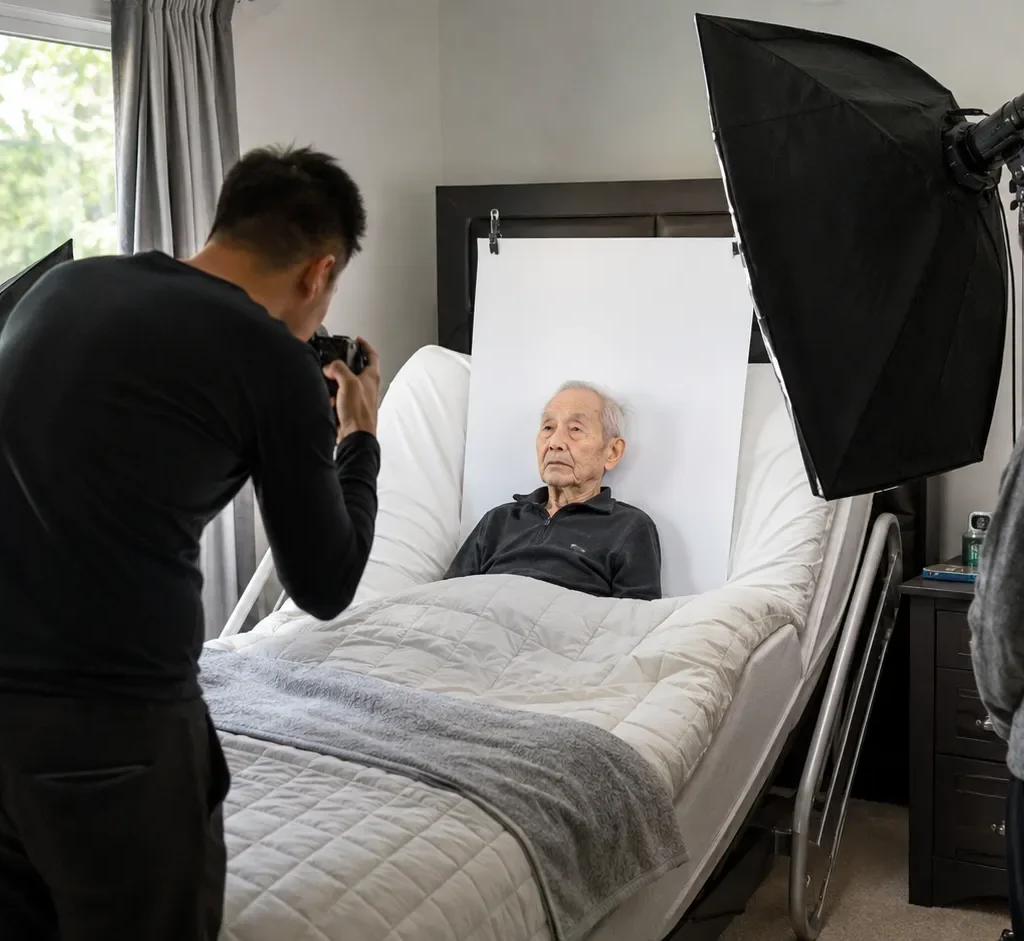
A Clean Background Is Essential
One of the hardest parts of photographing someone in bed is creating the correct background.
A bedroom may contain pillows, rails, medical equipment, blankets, monitors, or furniture immediately around the person’s head.
These cannot simply be digitally removed afterward.
The Government of Canada currently states that passport photos must be original and unaltered and specifically warns against digitally replacing or changing the background.
For this reason, the correct background needs to exist when the photograph is taken.
Our portable setup allows us to place an appropriate light-coloured background behind the client whenever the room and medical situation permit.
This is much safer from a compliance standpoint than attempting to Photoshop a hospital room out of the photograph afterward.
Never Photoshop a Passport Background
This deserves special attention.
It may seem easy to photograph someone lying in bed and then replace the bedroom or hospital background with white in Photoshop.
For Canadian passports, that can create a serious problem.
Current Government of Canada requirements state that passport photographs cannot be altered, including changing the background, making technical enhancements, or digitally correcting parts of the image.
That’s why we build the correct photography environment during the appointment.
The lighting, background, facial position, and camera angle need to be correct at the time the photograph is captured.
Bedside Passport Photos for Seniors
Many of our bedside appointments involve elderly clients.
A senior may live:
- at home
- in an assisted living residence
- in a retirement residence
- in a nursing home
- in a long-term care facility
- in a rehabilitation centre
- in a hospital
Transporting an elderly person solely to obtain a passport or identification photograph may require wheelchair transportation, caregivers, appointments, parking, and considerable physical effort.
A mobile photographer eliminates most of those complications.
Our Senior Passport Photo Service in Toronto is specifically designed for these situations.
We also regularly provide photography inside hospitals and care facilities. You can learn more in our guide to Mobile Passport Photos for Seniors in Toronto – Hospitals & Care Homes.
Safety, Cleanliness, and Infection-Control Considerations
A bedside passport appointment is very different from visiting a retail photo counter.
Many clients are recovering from illness, have compromised immune systems, or live in facilities with infection-control requirements.
We therefore keep the setup as compact and controlled as possible.
Frequently handled equipment is cleaned regularly, and families can inform us in advance about any special requirements.
For hospital, long-term care, or medically vulnerable clients, mask, gloves, or protective clothing can also be arranged when requested before the appointment.
If a facility has its own visitor screening, photography restrictions, PPE requirements, or entry procedures, those should be confirmed before the photographer arrives.
Our accessible passport service already supports appointments in homes, hospitals, retirement residences, and long-term care facilities.
What Equipment Does a Bedside Passport Photographer Need?
A professional mobile setup typically requires more than a camera.
For our bedside sessions, the essential tools can include:
- professional camera
- portrait lens
- portable studio lighting
- light modifiers
- portable neutral or white backdrop
- adjustable camera positioning
- professional photo printing
- accurate passport sizing tools
An experienced photographer also needs to understand perspective.
A perfectly exposed photograph can still fail if the head appears tilted or the face is photographed from the wrong angle.
This is why experience with mobility-limited clients matters.
How Long Does a Bedside Passport Photo Appointment Take?
A regular passport photograph can often be taken very quickly.
Bedside photography requires more flexibility.
The actual photograph may only take a few moments, but setting up equipment safely around the bed and finding the correct camera position takes additional time.
Our accessible mobile appointments generally allow approximately 30–50 minutes, depending on the client’s condition and the room.
There is no reason to rush someone who is uncomfortable, fatigued, or recovering from an illness.
What Should You Prepare Before the Photographer Arrives?
A few simple preparations can make the appointment much easier.
Whenever possible, tell us in advance:
- whether the person can sit at all
- whether they can move their head
- whether they use oxygen or a nasal cannula
- whether they’re in a hospital or LTC facility
- whether the bed can be adjusted
- whether staff assistance will be available
- whether the facility requires PPE
- what type of passport, visa, PR card, or identification photo is required
You do not need to move the patient or rearrange the entire room before our arrival.
We can assess the photography space when we get there.
Can a Family Member Help?
Absolutely.
For many mobility-limited clients, having a family member or familiar caregiver nearby makes the appointment easier.
They can help with communication and comfort and, where appropriate, assist with medically safe positioning.
However, hands or another person’s body should not appear in the final passport photograph.
The final image still needs to clearly show the applicant.
Canadian Passport Photo Requirements Still Apply
Even though the photograph may be taken in a bedroom or hospital room, standard photo requirements generally remain important.
Canadian passport photos must ordinarily be:
- 50 × 70 mm
- professionally photographed
- professionally printed
- sharp and in focus
- evenly lit
- against a plain white or light-coloured background
- centred and facing the camera
- representative of the person’s current appearance
- taken within the previous six months
For adult applications, the face size must normally measure between 31 mm and 36 mm from chin to crown.
For the complete specifications, you can also read our Canadian Passport Photo Requirements 2026 guide.
Professional Bedside Passport Photography in Toronto & the GTA
At Green Day Photography, our mobile passport service is built around clients who cannot easily use a traditional photo studio.
We regularly help:
- seniors
- bedridden clients
- wheelchair users
- hospital patients
- long-term care residents
- people recovering from surgery
- individuals with disabilities
- clients with severe mobility limitations
Our photographer brings the necessary camera, lighting, and background equipment directly to your location.
Instead of forcing the client to fit the studio, we fit the studio around the client.
Our mobile passport photography service currently covers Toronto, North York, Richmond Hill, Markham, Vaughan, Scarborough, Etobicoke, Aurora, and surrounding GTA communities. Extended-area appointments may also be available.
For current rates, visit our Passport Photo Pricing Toronto page.
Frequently Asked Questions
Can someone get a passport photo without getting out of bed?
In many situations, yes. An experienced mobile photographer can position the camera, background, and lighting around the client. The final photograph still needs to meet applicable passport requirements as closely as possible.
Does the patient need to sit upright?
Not necessarily. If sitting is unsafe or impossible, we assess whether the photograph can be created while the person remains in bed.
Can you photograph someone in a hospital?
Yes. We provide passport photography in hospitals, long-term care homes, retirement residences, rehabilitation centres, and private homes. Facility permission and visitor requirements should be confirmed beforehand.
What if the person cannot hold their head straight?
Government of Canada guidance states that applicants who cannot meet certain passport photo requirements for medical reasons should provide a written explanation with their application. Depending on the circumstances, additional medical documentation may be requested.
Can you Photoshop the background white?
For a Canadian passport, this should not be used as a workaround. The Government of Canada states that altered photographs—including digitally changing the background—can be rejected.
Can oxygen tubing appear in the photograph?
Canadian guidance allows medically required nasal cannulas, provided the eyes remain clearly visible; a signed explanation is required, and officials may ask for a doctor’s letter.
Book a Bedside Passport Photo in Toronto
Being unable to walk, stand, or sit independently shouldn’t make obtaining a professional passport photograph unnecessarily difficult.
With an experienced mobile photographer, professional lighting, the correct background, and careful camera positioning, many clients can have their passport photograph taken without leaving their bed, home, hospital room, or care facility.
Green Day Photography specializes in mobile passport photography for seniors and individuals with mobility challenges throughout Toronto and the GTA.
If your family member is bedridden or unable to visit a studio, contact us before the appointment and tell us about their mobility needs, location, and any medical or facility restrictions.
We will prepare the appropriate mobile setup and bring the photography studio directly to them.
Add a Comment